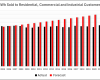
After forecasting 40 percent growth over 20 years, BC Hydro has been spending billions of dollars. But the utility’s sales to residential, commercial and industrial customers in calendar year 2023 were a mere one percent higher than in 2007.

After forecasting 40 percent growth over 20 years, BC Hydro has been spending billions of dollars. But the utility’s sales to residential, commercial and industrial customers in calendar year 2023 were a mere one percent higher than in 2007.

In 2017, Site C proponents said the dam was required because British Columbia needed dispatchable electricity. According to those keen on the megaproject, low-cost wind and solar power could not be integrated into BC Hydro’s systems. At the time, 97.5 percent of the utility’s generating capacity was hydro. Like batteries, reservoirs store potential energy. When consumers use electricity from wind and solar sources, hydropower utilities keep water behind dams, ready for use when needed…

The item below the separator was published in March 2018. That was three years before the Site C budget doubled to $16 billion, and we’ve now entered the fourth year since the dam budget was publicly updated. While overall inflation in Canada has been about 16% during the past four years, the non-residential construction industry experienced historic levels of inflation in 2022 and 2023. No one should be surprised when after the October 2024 provincial election, the Site C budget is revealed to be above $20 billion.
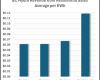
Repeated here is something I wrote about BC Hydro in early 2017 for The Common Sense Canadian, an online journal covering Canada’s economy and environment. The site was co-founded by Damien Gillis and the late Rafe Mair and ran for a decade. It remains a worthwhile archive of several thousand stories. A few statements are revised to reflect current information.

Years ago, Rafe Mair wrote that W.A.C. Bennett, if he were alive in 2009, would have been a member of the NDP, in those days a party firmly positioned on the left. Although he railed theatrically against socialists throughout his political career, Bennett knew that public ownership of near-monopolies was sensible…

Many self-interested people told us that non-destructive alternatives to hydropower would not work in British Columbia. These, they said, were unreliable and could not always send power to the grid on demand. Dispatchability was key, according to pseudo experts. This despite BC Hydro having reservoirs that act like giant batteries.

Energy-systems consultant Roger Bryenton wrote an open letter to Premier David Eby, BC Hydro CEO Chris O’Riley, and BCUC Chair Mark Jaccard. It is published here with permission.
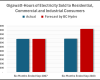
BC Hydro has often said that demand for electricity in this region is growing at a rate of 40 percent in 20 years. The company claims population increases result in greater consumption of electricity and vested interests tell us the utility must commit to major spending to serve the province. Self-serving messages are not meant to inform citizens of British Columbia. The intended purpose is to misinform. The strategy works. BC Hydro has been spending tens of billions of dollars because people pay little attention to underlying facts.

In 2018, BC Hydro began discouraging the production of solar power in British Columbia. The crown corporation had allowed customers with PV panels a two-way connection to the grid. When consumers fed surplus electricity to the utility, credits were recorded. If credits were not used to buy electricity from BC Hydro within a year, the utility would pay homeowners a price roughly equal to the average rate paid to independent power producers, or about one-half what Site C power will cost if it goes into service in 2025…

In November 2023, I examined falsehoods about electrical demand growth that have been repeated for almost two decades. People running BC Hydro still feel no obligation for accuracy and transparency when conducting public business…

Worldwide solar energy capacity has been growing rapidly. In 2022, it was 150 times higher than in 2006 and more than double the level of 2018 when BC Hydro moved to discourage solar power systems. A tiny proportion of the utility’s accounts was feeding solar power to the grid, but BC Hydro worried about added customers embracing solar, particularly large consumers of electricity…

So, who has been responsible for strategic misrepresentation that has damaged BC Hydro? Responsible Ministers and MLAs are driven by love of megaprojects, but they may also have experienced the Dunning-Kruger effect. They were educated by deceptive executives and experts who expected to earn material sums as BC Hydro expanded. The latter group has been successful, perhaps beyond their own expectations.
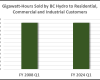
BC Hydro’s own numbers provide evidence that increased demand by domestic consumers over 20 years was less than one-third of that predicted and was double covered by the utility’s purchases from private power producers. But those facts did not stop the empire-builders from expanding their empire.

Seattle based writer David Roberts reports on energy matters. Recently Roberts explored the variability of renewable energy. Opponents of wind and solar power rely on this subject to raise objections. Despite virtually all of the electricity generated by BC Hydro being dispatchable, the public utility has discouraged addition of variable renewable energy (VRE).

Today, charts about BC Hydro showing information that ought to alarm citizens of British Columbia. It will not of course, because corporate media does not bother to report meaningful data about the province’s largest crown corporation. Despite their continuous claims that demand was growing by 40 percent over 20 years, the company’s own sales records show that demand was slowly growing until 2005 and since then has been stable. But that fact did not prevent the utility from amping up their spending machine…

In 2017, construction of Site C could have been halted without wasting more than $10 billion. But influential promoters of the megaproject — including Marc Jaccard, the newly appointed head of the “independent” regulator of BC Hydro — were misinforming citizens about the viability of alternatives…

Economist Erik Andersen emails an informal newsletter offering opinions, sometimes about how organizations and individuals use political influence to extract wealth from the public. He gave an example that was bad by itself but set the stage for secret private power contracts worth more than $60 billion despite expansion of the BC Hydro’s own generating capacity and a decade and a half of flat demand by consumers…

BC Hydro recently released its first quarter results for the fiscal year ending March 2024. The report covered three months in 2023: April, May and June. It is worth looking at the changes at British Columbia’s public utility since June 2007.

When BC Hydro said that growing demand required asset additions worth billions of dollars and contractual commitments of $50+ billion owed to independent power producers, should we have believed what they said? The record clearly states the answer was NO.

Lew Edwardson wrote the following as a comment on the post Lack of transparency at BC Hydro may conceal massive fraud. It deserves to be repeated in this separate post. WARNING: this will not build confidence in elected officials and senior public servants.


BC’s “old” New Democratic Party took Climate Change “very seriously”. That’s what they said. According to The Tyee the “new“…
Trump still not wining in court. LIZ - Trump loses again https://www.youtube.com/shorts/-sR08kt2ckE?feature=share LIZ – Trump loses Tariffs in supreme court…
Windmills for Britain? Really soon? Nope. Is it possible that “two-tier” Sir Keir Starmer is catching up to energy reality?…
The UK now wants to emulate Norway on EVs? Yes, how Norway has adapted to the the Iran War is…
 in-sights.ca
If the question is how to bolster public support with new ideas maybe The UK needs some advice from Spain…