An examination of revenue the Province of British Columbia has taken in from production of fossil methane gas in the fiscal years 2000 to 2023.
Gwen and I raised three adult children in North Vancouver. Each lives in this community, as do our seven grandchildren. Before retirement, I worked in accounting and small business management. Since 2009, I have published commentary about public issues at IN-SIGHTS.CA.
An examination of revenue the Province of British Columbia has taken in from production of fossil methane gas in the fiscal years 2000 to 2023.
A key element of Canada’s future climate policy is carbon capture, utilization, and storage (CCUS). The federal government is spending hundreds of millions of dollars to advance the commercial viability of CCUS technologies. Despite what critics say about CCUS, it is working as intended for fossil fuel producers. CCUS is not a solution, it is a distraction. The aim is to justify ‘continued production of carbon rich energy.
BC’s NDP government promised, “On May 19, 2022, the Province introduced a new oil and gas royalty system that puts the interests of British Columbians first and eliminates outdated and inefficient fossil-fuel subsidies.” More than fifteen months later, we learn from the province’s just released audited financial statements that subsidies by way of royalty credits taken in one year by producers increased by $154 million to $1.7 billion. In addition, another $2.3 is available for producers to reduce or eliminate future royalty payments.
Eliminating methane emissions offers huge potential for quick, affordable climate action. Modern technology makes identification of leakage relatively simple, but industry and governments are dedicated to increased fossil fuel production. As a result, methane leakage is consciously underreported and methane abatement actions are not taken.
As a change from the usual subjects at In-Sights, here are photographs taken by Lorne Simpson of Victoria, a friend of 50 years or so. Lorne is a keen observer and a multitalented artist. To record scenes, he might use a paint brush or his phone, but he might also use a 4″ X 5″ large format camera. I think these photos might interest readers of In-Sights.
After 28 years as a key contributor at the Georgia Straight, Charlie Smith moved to Pancouver, a new arts and culture media outlet that aims to “shed light on how this history has shaped artistic creation in Vancouver.” Charlie Smith occasionally writes at Substack and recently he asked if it was “time for Canada’s older political journalists to call it quits?”
Strategic interventions to cut methane emissions in the natural gas supply chain are relatively simple and cost-effective compared to the complexity and expense of decarbonizing the global economy. Prohibiting venting and routine flaring and incorporating routine equipment fixes and upgrades into maintenance plans can significantly cut methane emissions from production sites.
Proponents tell us that fossil methane gas emits fewer greenhouse gases when burned than coal. “Natural Gas” has long been sold to us as a reliable, environmentally friendly, even classy energy source. But end-use combustion is only part of the story. Total GHG life-cycle emissions from extraction, processing and transport of this fuel reveal this mixture of gaseous hydrocarbons ia a prime cause of global warming and a problematic source of pollution within our homes…
Premier David Eby and Ministers of British Columbia spent much time in August 18 news conferences. They talked about dealing with wildfires and assisting the tens of thousands of people affected by the province’s hottest ever time for burning. Politicians spent little time talking about factors that contributed to the current State of Emergency…
The UK’s Royal Meteorological Society wrote about the deadly heatwave that affected western North America in 2021. An underlying message was to prepare for more disasters like the destruction of Lytton, BC. This might happen even if governments get truly serious about climate change, an unlikely scenario even as death and destruction mounts.
Reader help is needed and much appreciated. When supporting news and information web pages, please consider IN-SIGHTS.CA. After 14 years, survival of this advertising-free site is at risk. Reader contributions are needed to offset internet, computer, and research charges, site hosting costs, and subscriptions to numerous news sites in North America and Europe. Any amount is appreciated.
Substance use disorder (SUD) affects human’ brains and behaviors, leading to uncontrolled use of substances. Symptoms can be moderate to severe. For individuals, this might involve drugs or alcohol. For industrialized societies, it certainly involves fossil fuels.
Hollow promises by politicians are worthless. Thermal coal continues to be exported from British Columbia and capacity to handle this dirty fossil fuel has been significantly increased. The vast majority of coal reserves must stay in the ground.
Ethics and morality have little to do with today’s self-serving radicals who falsely label themselves conservative. In too many cases, politicians promising responsible management of taxpayers’ assets have shunned prudent exercise of power. They tolerate extensive damage to the planet so that financial rewards can flow to corporate cronies and financial supporters.
University of Manchester’s Dr. Kevin Anderson is a visiting researcher in the Department of Earth Sciences at Sweden’s Uppsala University. Anderson warns that continuing on our current path will result in a catastrophic outcome due to climate change. He cautions against believing the political rhetoric about progress and says the concept of NET-ZERO really means NOT-ZERO. He believes the commonly used expression is cover for an unacceptable plan to kick the can down the road.
Over the years, clean renewable power costs have decreased steadily and efficiencies have improved. The British Columbia government and the main public utility offer few incentives for creation of energy near to points of consumption. Green electricity must displace fossil fuels but the NDP allows BC Hydro to maintain its near monopoly while it discourages local cooperatives seeking to create power for self-consumption. Provincial decision makers cling to business models rooted in the 1960s.
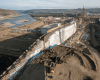
A pumped-storage hydroelectricity (PSH) facility moves water into a high-level reservoir during times of low demand, and then generates electricity by releasing water during times of high demand. Most storage occurs at night and most electricity is generated during the day. PSH is a proven method of energy storage with competitive round-trip efficiency and long life spans.
New York Times science writer David Wallace-Wells, author of The Uninhabitable Earth, issues a weekly newsletter for subscribers. The August 2 edition is a powerful and disturbing look at the future.
Powerful people are willing to destroy us to enrich themselves. Governments are willing accomplices. Canada Energy Regulator says western Canadian fossil gas production hit an all-time high in November 2022, a year that included at least eight of the top ten producing months since January 2000. There are no plans to limit production. Instead, governments and industry plan major increases in fossil gas output.
Despite false claims by organizations paid to promote false claims, clean renewable energy must replace fossil fuels. The only question is when. The inevitable is assured by crucial environmental, social and economic benefits…
If you require high standards a good place to look for clarity is Liz Oyer. Liz - Blanche takes down…