
Access to years of BC Hydro’s financial reports provide me with an indisputable record of the utility’s financial destruction. Eleven years ago, one citizen didn’t have detailed evidence but he did have foresight…

Access to years of BC Hydro’s financial reports provide me with an indisputable record of the utility’s financial destruction. Eleven years ago, one citizen didn’t have detailed evidence but he did have foresight…

Most readers will be familiar with Erik Andersen, an expert commentator about economic matters in BC. This is the original text he submitted to the Vancouver Sun after the newspaper published an […]

Disputing parties in arguments about Site C belong to either of two camps. One is populated by people wanting a share of the billions of dollars to be spent; the other by people who will be forced to pay the huge sums.

When you’re an activist for vested interests, complete and accurate reports are never offered. These might educate low-information voters that have supported BC Liberals for many years.
A recap of my Twitter comments about Site C.

British Columbia Utilities Commission will release its second Site C report on November 1. I expect this will provide further information but not a definitive recommendation. But, of course, the buck stops at John Horgan’s cabinet table. Proceeding with Site C without independent review was a major Liberal blunder. If you are trying to get out of a hole, the first act is to stop digging. The economic and cultural factors say stop Site C now.

Corruption is particularly relevant for megaprojects because of their intrinsic characteristics. Megaprojects are projects characterized by: large investment commitment, vast complexity (especially in organizational terms), and long-lasting impact on the economy, the environment, and society…

We know the Premier vowed to get Site C dam past the “point of no return” before the May 2017 provincial election. Clark’s Liberals have their own reasons for Site C haste and these eventually will be revealed, perhaps by a postmortem report of an inquiry into the economic destruction of BC Hydro. However, we do know that incautiously pushing a project forward can be costly. Unfortunately, the cost of error will fall not on decision makers but on taxpayers not wealthy enough to hide their income elsewhere.

According to Financial Post writer Geoffrey Morgan, BC Hydro sent an October 3 communication to the BC Utilities Commission (BCUC). The letter explained why it continues to forecast a surge in electricity demand, despite a dozen years of flat sales to BC consumers…

When British Columbia’s new government took power In July, they quickly changed the CEO, the Board Chair and two other directors. That left in place most of the hierarchy that managed the utility into its current disastrous condition. More changes are needed. Immediately.

Clearly, Site C is not intended to meet the needs of existing BC Hydro customers. As noted, demand and supply are in balance for the next decade, even without aggressive efforts of conservation, the greenest solution to energy shortages.
There is another source of electricity readily available. It is Revelstoke Unit 6…

I originally published A false notion in June 2010 and repeated it two years later. It came to mind after Postmedia’s senior west coast pundit wrote B.C. Hydro’s Site C promises ring hollow. […]

Brady Yauch is an economist at the Consumer Policy Institute (CPI), which identifies itself as “an independent think-tank dedicated to achieving lower costs and greater efficiencies for Canadian consumers, particularly in sectors run by government monopolies or those receiving large subsidies.” Mr. Yauch published a powerful examination of mismanagement at utilities in four Canadian provinces. I recommend reading the entire linked document but extracts follow that refer specifically to British Columbia. Regular readers of In-Sights will not be surprised at the stated facts but they’ve been routinely ignored by the province’s most experienced political pundits. The information doesn’t suit their political purposes.

Muskrat Falls was always a done deal, and a bad one says Pam Frampton, Saint John’s Telegram. “One week the project was all about clean energy, the next it was job creation, then it was all about being an affordable energy source, then it was a means of foiling Quebec, then it was a lure for mining companies.” The Progressive Conservatives’ sales pitch was scattershot; they threw out a whole bunch of messages and hoped something would resonate with people… Many people worried that the project might be far more than we needed or could afford.

You are a stakeholder in the Peace… It’s time to take a stand and plant your stake to support the cost of the First Nations’ legal battle to STOP SITE C + SAVE THE PEACE RIVER VALLEY. $100 DONATION (tax receipted) plants A YELLOW STAKE (with your name + city name) on the third-generation Boon Farm, which BC Hydro wants to acquire/expropriate… 100% of funds raised directly support Prophet River and West Moberly First Nations legal challenge to Protect the Peace River Valley.

The government’s reckless decision to proceed with the $8.8 billion Site C dam project, without a proven medium term domestic need for the additional power, will seriously weaken BC Hydro’s already poor financial outlook. Possible options to finance the dam must not preclude the fiscal capacity of BC Hydro to reform and restore its existing financial situation, within the context of future affordable rate increases…

Anne Cameron: Well, we’re less than 300 fulltime residents, we’re at the end of a goat track, we’re an hour and a half out of Gold River and, frankly, who gives a poop. We’re being fleeced by two corporations, and we’re being screwed by the government which allows out-of-sight out-of-mind pillage which they will insist on calling “resource extraction”.
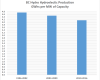
After four decades of successful operation, BC Hydro changed drastically under Campbell/Clark Governments. It’s become a patronage playpen, with the chief executive suite and the boardroom peopled with loyal Liberal friends. It’s been a comfortable ride for BC Liberals but a disaster for residents and small-medium businesses. Now the incompetents want to make it even worse by delivering billions more to companies of questionable integrity. Important Site C contractors have been implicated in corrupt and questionable practices.

The structure of the Canadian Entitlement makes it an extremely valuable commodity in the utility industry. Electricity is more valuable when it is virtually guaranteed to be available, or “reliable,” and when its delivery can be shifted to times of high demand, or “flexible.” The Canadian Entitlement offers both of these attributes. British Columbia’s sale of 4,540 GWh of electricity brings in about $120 million a year, which is 2.64¢ per Kwh. We didn’t need that power because, with ever-increasing purchases from independent power producers (IPPs), the province had surplus electricity. In the last reported quarter, December 2016, BC Hydro paid an average of 9.14¢ a KWh to IPPs. Had BC replaced IPP power with the Canadian Entitlement, at 9.14¢/KWh, it would have saved $295 million in 2016.

BC Hydro’s own statistics prove the utility has no good business reasons to be building Site C. Domestic customers use the same volumes of electricity today as a dozen years ago and rapidly rising prices will ensure further conservation moderates consumer demand. BC Liberals argue the new dam should be built, not because it is needed, but because it is providing jobs. That, of course, fails to account for financial damage to commercial and industrial enterprises hit with rapidly rising electricity rates. The competitive advantage of low cost electricity once enjoyed by BC employers has been squandered.


And then there is the OIL & Gas!!!!!!!

Historians have not been kind to elites who opposed scientific innovation. For centuries Belief among guardians of executive authority rarely…

The last thing these guys think about is a healthy society. They live in a world where prestige and wealth…

[…] In a June 2024 subcommittee hearing, U.S. Senator Josh Hawley questioned Boeing CEO Dave Calhoun on the company’s safety…
 in-sights.ca
The US influence extends it's foreign policy to unwitting allies with the UK and Canada being prime examples. With this…